Supercharge Your Studying
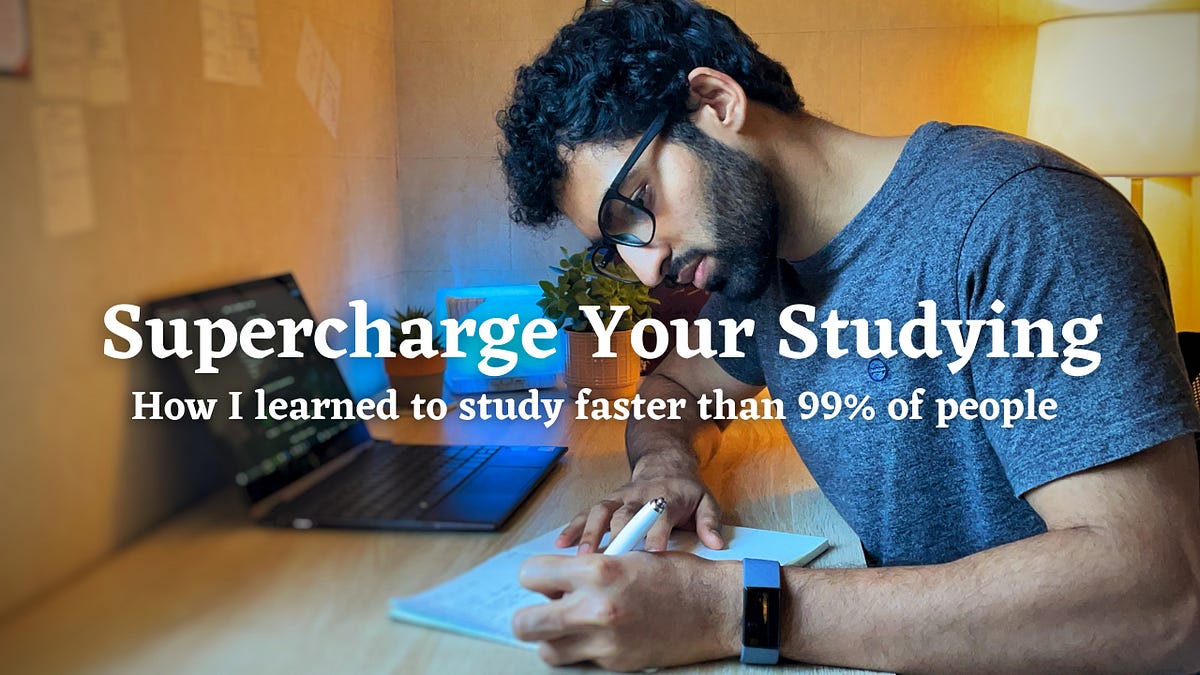
How I Learned to Study Faster Than 99% of People

Everyone underestimates speed. The hardest thing about medicine is the volume of content and speed is the #1 hack to overcome that. It’s why I’m able to create content, consistently do well in exams and maintain a healthy lifestyle. I’m nothing special, I’m just quick.
Work faster = Finish sooner = Have fun
Here’s how I do it 👇🏽
3x Speed
I play all of my lectures at 3x speed. I think that's self-explanatory that I'll get through them much faster than 1x speed.
It's not easy to jump from 1x to 3x so I suggest you gradually increase the speed over time. When I started medical school I was only comfortable with 1.75x. Now I can often go up to 3.5x. Your brain will get used to processing the sounds faster. Try to keep the speed just slightly over your comfort zone, that way you're always challenging yourself to listen faster and you will improve over time.
If your university uses Panopto for recorded lectures then use this link which lets you manually select the speed to one decimal point. YouTube also has a similar link so you can manually select the speed of YouTube videos.
If you’re fortunate to have captions on your lectures, that’s even better because your brain can read faster than you think, so captions help.
This has such a big impact, I no longer feel intimidated by 50-minute lectures since I can get through them in 25 minutes or less.
Typing Without Looking
During my gap year, I learnt how to type without looking. My typing speed before was 50WPM (Words Per Minute). Now 3 years later with not much intense practice, my typing speed is comfortably 80-100 WPM. That means I can type an essay almost 100% FASTER than before.
This, in my opinion, is the most important skill every adult should learn. We have to use computers for everything these days so being that little bit faster is a huge advantage. It’s also kinda cool to be able to do this.
I used this FREE website to learn how to type without looking. Just follow the lessons from start to finish. It took me 30 days of lessons to get to a point where I could comfortably type without having to look at the keyboard.
Typing speeds can go up to 170ish WPM so there's a long way for me to go yet, but even at 80-100WPM I'm seeing huge results.
Keyboard Shortcuts
This is called micro efficiency. It's where you save yourself fractions of seconds which build up over time and collectively save you A LOT of time.
This website has a big list of keyboard shortcuts. I write 5 of them out on a piece of card and stick it on the wall in front of my desk. Each set of 5 takes me a few days to get used to, then I put a new set of 5 up. I've lost count of how many shortcuts I've learnt but they save so much time.
I can almost navigate my whole laptop without ever having to touch my mouse, so when I'm doing a lecture everything is sped up. I also know every single Anki shortcut by heart. I can make flashcards faster than the lecturer can speak (Typing without looking + Keyboard shortcuts).
It also gives me a dose of the feel-good hormone. I sort of feel like a computer mastermind when I CTRL+TAB, CTRL+T and CTRL+L to search for something on the internet, followed by a CTRL+W to close the tab and CTRL+TAB to return back to my workspace.
It might not sound like much but trust me, those microseconds add up.
Work Smart, Not Hard (actually explained)
If you want an in-depth version of this point watch this lecture.
Many students think good grades require hard work and long hours, but it doesn't. You can get the same grade as someone who works twice as much as you do if you work smart.
Medicine is taught all over the world and it's the same everywhere. Tuberculosis is Tuberculosis whether you're in Australia, the USA or the UK. That means you should never need to take notes on it, or any other disease, since you have the internet and other people have done that for you.
I literally just googled tuberculosis in under 60 seconds and found these 4 links (1, 2, 3, 4). Each one gives you ALL of the information you need. Now you don't need to make notes on it, you can simply just copy and paste the notes from these websites and within 15 minutes you have a giant summary of the disease along with 4 resources should you need to look something up.
Now you can just watch your university lecture and refer to these websites for 'notes'.
Your goal with studying is to get the information into your head, not into your notebook. So stop worrying about making notes and start worrying about whether you can understand and memorise them.
Another smart method is to type your notes. Typing is inherently faster than writing, especially if you can do it without looking.
These are just a few of the methods you can use to study smart and not hard.
All I want is a good grade and a good understanding in the shortest time, how I get there doesn't matter.
Focus On The Core
This is something that works for medicine, I imagine it works for other degrees and forms of learning too.
Basically, you go through each topic and only focus on the core information. I'm learning about the diseases of the Cardiovascular system currently and there are around 30 different diseases to learn about.
Instead of going through them one by one in significant detail, I focus on getting the core idea of what each disease is, then I go back through them again with more detail.
I repeat this cycle 3-4 times and each time I do a new cycle, I revise what I studied in the previous cycle, so by the time I reach cycle 4 I've been through the core material 4x.
This strengthens your understanding of each individual topic and also helps you build a bigger picture to tie everything together.
In medicine, everything is interconnected. You can't learn about diseases in isolation because one leads to another and they have overlapping symptoms, treatments and causes. Beginning with the core helps intertwine the linked diseases. It also stops that overwhelming feeling of despair when you look at details too early and realise how much work you actually need to get through.
You’re wasting time
There are times when I have to go to a lecture and I simply don’t want to be there. Most students accept this and sit idle, listening or scrolling on their phones. That’s a waste of time.
Instead, find some work you can do while in the lecture.
Clean your emails. Plan your day tomorrow. Do some flashcards. Write a grocery list.
Literally anything that could make your time worthwhile.
This has been a very effective method of work. I’m very protective of my time and I don’t like to waste any of it.
Artificial Deadlines
Parkinson’s law states that work fills the time we allocate to it. If I give you 6 weeks to complete a task you will likely take 6 weeks to do it. If I gave you 6 days you would probably get it done within 6 days. The issue with lectures is they don’t have deadlines like exams.
Give yourself artificial deadlines for your work.
The idea is not to strictly stick to them, but it’s to create a sense of urgency. Your brain is more likely to take something seriously when you have a clock ticking down.
Sometimes I like to tell a friend I’m going to get X done by tomorrow. That gives me a false deadline and some accountability. I often do this on social media too with YouTube posts or this newsletter. I post a story saying ‘New post at 6pm’ when I haven’t finished it yet so I’m forced to get it done.
I hope you realise that these tips are simple. There is no actual ‘secret’ it’s just obvious things that very few people do. I combined all of them and the result is I’m always ahead. I’ve been doing this for 3+ years so I learn shortcuts all the time.
Next time you have work to do ask yourself, what’s the fastest possible way to get this done without compromising quality?
Originally published on Substack.